
Our bicycle touring history began when Katherine Erickson circled Lake Superior, starting and ending in her hometown of Duluth, MN.
She traveled through evergreen forests along the lake, on routes and past sites that she had previously experienced only by car.
With a bicycle offering reduced speed and removing the isolating effects of car windows, she saw the area in a new, and for the most part better, light.
But in some ways, bicycle travel exposed her to a darker side of the Northwoods.
The route was one of few along the north side Lake Superior and a common trucking route, its vastness tempting drivers to drive fast and carelessly.
One consequence of this was visible in the number of dead animals alongside the road.
Most everyone knows about roadkill, and many of us have run over animals ourselves; in many cases it is unavoidable.
But in a car traveling 60mph, most of the dead animals you pass go unnoticed or are quickly forgotten.
The sheer number of animals that are killed on our roads is shocking to see if you have never traveled slowly down the side of a highway.
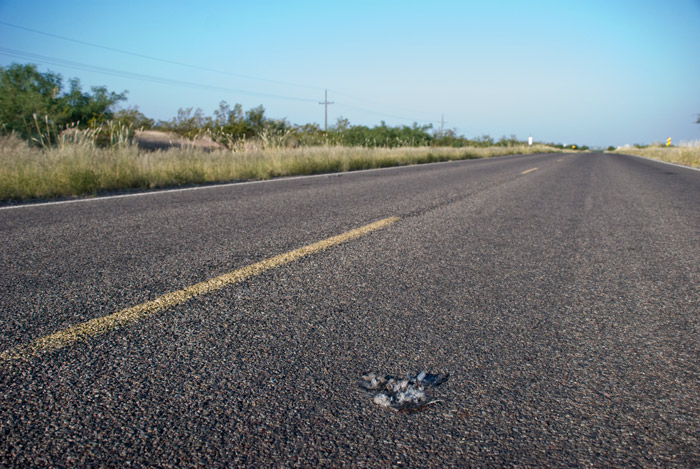
--> Before bicycling across the United States in the fall of 2008, we decided to record the roadkill that we observed. This project is not intended to disturb the audience, or to blame drivers. It encourages the viewer to consider the extent and sadness of the problem, and it suggests ways of addressing it. While bicycling past these animals, we felt no indignation at the cars going too fast to notice them. Rather, we felt disturbed that we had never fully realized the dangers that highways present to wildlife, and we wanted to help raise awareness about the problem.
You can drastically reduce your personal impact by driving less and driving safely, especially in wild areas. Additionally, you can support programs and legislation that incorporate wildlife planning into highway construction to promote a healthier coexistence between our roads and nature.
Our route and the number of animals seen each day are summarized in the Route section. The total numbers and the kinds of animals we identified are discussed in Data. Photographs we took of the animals can be seen in Gallery. To read more about the impacts of roads and the things you can do to alleviate the problem, visit More Information.
- Katherine Erickson and Michael P. Geraci